
The connectivity of the land section between Porto Alegre (Brazil), Buenos Aires (Argentina) and Santiago (Chile) of the BELLA Program
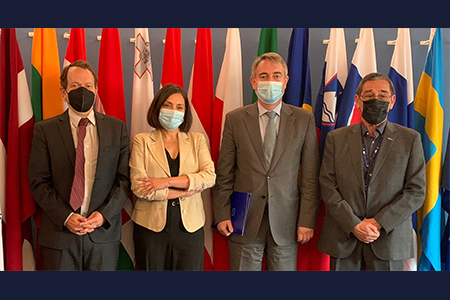
The connectivity of the land section between Porto Alegre (Brazil), Buenos Aires (Argentina) and Santiago (Chile) of the BELLA Program (Building the Europe Link to Latin America) was officially inaugurated this Wednesday, January 26, in an event held virtually, with the participation of authorities from the European Union (EU), the governments of the participating countries and the national research and education networks of Latin America.
Present at the launch ceremony were the European Union (EU) Ambassador to Chile, León De La Torre, the Deputy Director-General of the EU's DG International Partnerships (INTPA), Myriam Ferran, the Acting Deputy Director-General of the EU's DG Connect, Thomas Skordas, the Secretary of Innovation of the Ministry of Science and Technology of Brazil, Paulo Alvim, the Director of the National Research and Development Agency of Chile (ANID), Aisén Etcheverry, the EU Ambassador to Brazil, Ignacio Ybañez, the EU Ambassador to Argentina, Amador Sánchez Rico, the Executive Director of RNP, Nelson Simões, the Executive Director of REUNA, Paola Arellano, the Director of the Interinstitutional Laboratory of e-Astronomy (LIneA) of Brazil, Luiz Nicolaci da Costa, the Copernicus representative in Chile, Florencio Utreras, and the Executive Director of RedCLARA, Luis Eliécer Cadenas.
The inauguration of this connectivity marks a historic milestone for the development of science, education, technology, and innovation on the continent and its relationship with Europe. The segment comprises 6,070 km of terrestrial telecommunications infrastructure, with capacities of up to 600 Gbps, which will benefit more than 1,550 university campuses and research centers in Chile and Brazil, paving the way for the future connection of Argentine institutions. This new connectivity will bring numerous benefits to the Copernicus Programme in Chile and to astronomical research in Brazil.
In his opening remarks, Luis Eliécer Cadenas likened BELLA to a digital embrace between the participating countries. “I like to imagine this as an embrace that strengthens our historical ties in all areas, including, through RedCLARA and its members, the fields of science, technology, education, and innovation, which are fundamental to the economic and social development of our society,” stated the Director of RedCLARA.
Myriam Ferran, Deputy Director-General of the EU's DG International Partnerships (INTPA) (a co-funding institution of BELLA-T), described the alliance between the European Union and Latin America through BELLA as a model to be followed: “We share not only the same values, but also the challenges and objectives of this digital age. We will work side by side with you for a digital society and economy that puts people at the center. We believe that digital technology is key to fostering innovation, and for this reason, we thank RedCLARA and the national research and education networks of Latin America for embracing this challenge with us.”.
According to Nelson Simões, Director of RNP, BELLA's success was only possible thanks to the joint effort between national research and education networks (NRENs), national governments, and the European Union. “This infrastructure wouldn't be possible with national academic networks alone. These networks became relevant because they managed to materialize and demonstrate the results of public policies. Without our state governments, which invest in quality education and collaborative research, there wouldn't be any emerging technology or organization capable of promoting science and education for all,” he explained.
Simões also attributed the project's success to the investments made by academic networks in their respective countries and, to a large extent, to the collaborators who develop and contribute their technical skills along the way. “Thanks to our extraordinary teams, we were able to collaborate with GÉANT and RedCLARA on the development and training of BELLA-T and integrate communities from Europe to Latin America like never before,” stated the Director of the Brazilian academic network.
For the EU Ambassador to Argentina, Amador Sánchez Rico, BELLA will enable the country, once it joins the Program, to advance initiatives in artificial intelligence, blockchain, and the technology of things, as well as climate science, health, and telemedicine. Meanwhile, the executive director of REUNA, Chile's academic network, Paola Arellano, highlighted the importance of the new connection for her country and the region: "Latin America, and Chile in particular, are enormous natural laboratories; Chile alone is home to 75% of the world's astronomical observatories, for example. That's why BELLA is fundamental for bringing people, institutions, and countries together, for sharing knowledge, facilitating access to resources, transforming education, and contributing to economic and human development," she celebrated.
Among the observation projects that will benefit from the new connectivity is Copernicus, whose head in Chile, Florencio Utreras, was also present at the launch. He presented an overview of the project and reaffirmed the importance of BELLA for initiatives monitoring greenhouse gases, glacial movement, forest fires, red tides, volcanic activity, and more: “The work of monitoring the Earth is tremendous, and when there are emergencies, information must be sent quickly. We can't just put it on a hard drive and send it by mail; we need fast networks, and BELLA is here to help us with that.”
For Luis Eliécer Cadenas, the inauguration marks an important moment in the history of cooperation between countries and continents, but this collaboration must continue. “Above and beyond digital capabilities, there are the people, the human work that truly makes BELLA what the project was created to be. We need to keep collaborating; the work has only just begun,” Cadenas concluded.
ABOUT BELLA
The BELLA Programme addresses the long-term interconnectivity needs of the research and education communities in Europe and Latin America. This is being achieved through two complementary and interdependent actions that will significantly enhance the capacity of researchers and academics from both regions to collaborate. These are BELLA-S (its underwater component, between Fortaleza, Brazil, and Sines, Portugal) and BELLA-T.
For more information about the BELLA Program, please visit the following link
To attend the live stream of the launch ceremony, visit the RedCLARA YouTube
Source: Red Clara