
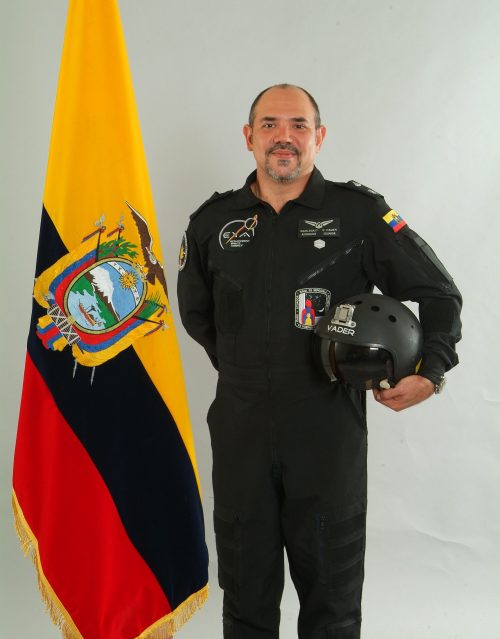
Meet Ronnie Nader: Ecuador's First Astronaut
Within the framework of inter-institutional cooperation with the Ecuadorian Civilian Space Agency – EXA, we have maintained several approaches with the aim of promoting future collaborative actions.
Among the aforementioned approaches, we conducted an interview with Ronnie Nader to gain a deeper understanding of the agency's management and the expectations generated by the inter-institutional collaboration with CEDIA.
Ronnie Nader is Director of Space Operations at EXA, President of the Latin America and Caribbean Regional Group of the International Astronautical Federation (IAF), and a Permanent Member of the International Academy of Astronautical Sciences (IAA).
My current role at EXA is to lead the development of our own space technology and test it in orbit, at the IAF it is to promote Latin American space development with an emphasis on youth, and at the IAA it is research in space engineering sciences on advanced human spaceflight technologies.
Considering that EXA was founded more than 10 years ago, and according to the Space Program outlined in 2007, the first Ecuadorian satellites were planned for launch in 2016, but were launched in 2013. There was no mention of achieving the world record for microgravity, but we accomplished it in 2008. We had planned to begin exporting Ecuadorian space technology in 2018, but we started doing so in 2016. I believe I have exceeded the goals set by EXA in the 2007 Space Program.
The whole time has been pleasant, as I work in what I was born to do, but I remember special moments, like when we achieved the world record in the EXA/FAE-06 mission in 2008, when we launched HERMES-A, our ground station; the night of April 25, when we launched our first satellite PEGASO and that same night I was able to hear its transmission from space and the morning we recovered its signal thanks to our second satellite, KRYSAOR.
The night we lost the PEGASO signal due to the collision with space debris over the Indian Ocean.
I wouldn't know how to answer that, the truth is for me there has never been much difference; I was born an astronaut, it just took me 40 years to prove it to the Russian Government and the world.
Frankly, I don't see much technological development in Ecuador, aside from what EXA is doing. For example, a month ago, an institution in the United States asked us to design, develop, test, and ship a Class 4 laser for a satellite launching in August on a NASA rocket, meeting the highest standards. We shipped it three days ago, and two hours before writing this, it arrived in the United States. This sounds like a miracle to anyone, but we were able to do it this way because we essentially adapted one of the many lasers we already had from another research project developed two years ago.
So, in reality, it wasn't 30 days; it was more than 18 months of experience and investment that paid off. But when we were developing that project, we had no idea that we would apply what we had learned to something very different. That's right, research is like sowing seeds; it's hard work that bears fruit with the harvest, but you always have to keep watering and fertilizing. Research in science and technology isn't a sport, it's not a soccer game where you win and lose. In this field, the word 'failure' doesn't exist. That's for those who play to win or lose, and we're not playing here. We're constantly working and researching, and the only failure is stopping.
So, from that perspective and line of work, I don't see any of that in Ecuador; it doesn't mean it doesn't exist, it's just that I, personally, don't see it.
That the goals set are met, in reality in these 10 years of existence EXA has signed many agreements with many institutions, but rarely do we even begin to work on them and not for lack of ours, because for us the written or spoken word constitutes a true commitment and I sincerely hope that this time will be different.
I hope that we can truly work and make what we have committed to a reality. We will never lack the will or the time. Our country needs a lot of work to create sustainable development, and that won't be done by doing more of the same old things, marching on the same ground. We need to do new things, and that's what scientific research and technological development are for: going where we haven't gone before, even if others have already arrived. What matters is that we have arrived, because no one can live by themselves, and perhaps we could do it better, faster, and stronger, and that is what humanity knows as progress.